
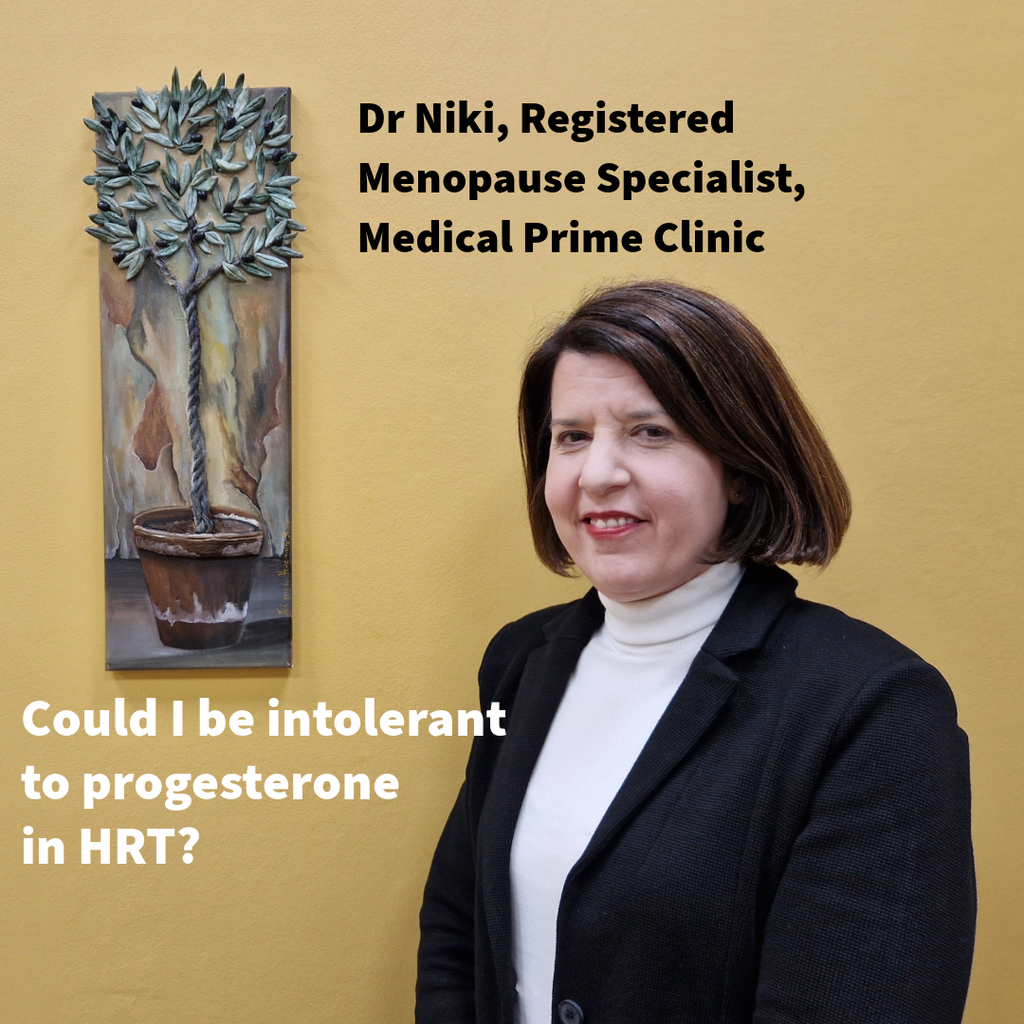
Could I be intolerant to progesterone in my HRT? Dr Niki Davies, Registered British Menopause Society Menopause Specialist
You’ve started HRT hoping to feel more like yourself again. But instead, something feels off.
Maybe your mood has dipped, you feel more anxious than usual, or you’re dealing with bloating, headaches or brain fog that was not there before. You might even have noticed a pattern where these symptoms seem to appear during certain parts of your HRT cycle.
It can be frustrating, especially when HRT is meant to help.
For some women, the progestogen part of HRT can cause noticeable emotional or physical side effects. People often call this “progesterone intolerance”, although not every HRT preparation contains progesterone itself.
What does progesterone intolerance actually mean?
Progestogen is the broader term for hormones used alongside oestrogen to protect the lining of the womb. This includes micronised progesterone as well as synthetic progestogens.
Some women are more sensitive to their effects. This is often described as progestogen intolerance.
It does not mean your body is rejecting progesterone or that you cannot use HRT. It means that certain types, doses or ways of taking progestogen may cause side effects that are difficult for you to tolerate.
Progestogens can affect the brain and nervous system as well as other tissues in the body, which may help explain why some women notice changes in mood, energy or physical symptoms.
The response varies considerably. Many women tolerate progestogens without difficulty, while others notice a much clearer change.
What symptoms can progestogens cause?
Possible symptoms include:
- Low mood or feeling flat
- Anxiety or increased emotional sensitivity
- Irritability or mood swings
- Headaches or migraines
- Bloating or fluid retention
- Breast tenderness
- Fatigue
- Brain fog
- Acne or oilier skin with some types of progestogen
Timing can provide an important clue.
If you are using sequential HRT and symptoms repeatedly appear during the days you take the progestogen, then improve after that part of the cycle finishes, it is worth discussing whether the progestogen may be contributing.
That pattern is not proof. Mood changes, headaches, fatigue and bloating can all have other causes too.
This is why looking at what happens repeatedly over several HRT cycles can be more useful than judging the treatment from one difficult day.
Does the type of progestogen make a difference?
It can.
Micronised progesterone has a different pharmacological profile from synthetic progestogens, and some women find that they tolerate it better.
That does not mean it will automatically cause fewer side effects for everyone.
Different synthetic progestogens also have different effects, so changing from one type to another can sometimes make a noticeable difference.
The important thing is not to assume that struggling with one preparation means you will react in exactly the same way to every other option.
What can be changed if I am struggling with it?
If the pattern strongly suggests that the progestogen part of your HRT is causing problems, you do not necessarily have to stop HRT altogether.
Your doctor or menopause specialist may review the whole regimen and consider options such as:
- Switching to a different type of progestogen
- Switching to micronised progesterone if appropriate
- Adjusting the dose or schedule under medical supervision while making sure there is still enough progestogen to protect the womb lining
- Changing between continuous and sequential HRT when appropriate
- Considering a 52 mg levonorgestrel intrauterine system such as Mirena, which can provide the progestogen needed to protect the womb lining while limiting systemic exposure
- In selected cases, discussing vaginal use of micronised progesterone if oral treatment causes troublesome side effects
- Reviewing whether the oestrogen dose and the rest of the HRT regimen are appropriate
Vaginal micronised progesterone is an off-label approach in HRT and needs clinician guidance because the evidence on the best dose and regimen is more limited.
Changing to sequential HRT can reduce the number of days some women take a progestogen each month, but it usually produces a withdrawal bleed and is not the right long term option for everyone.
The aim is to find a regimen that controls your menopause symptoms while still providing the protection your womb needs.
Do I still need progesterone if it makes me feel worse?
If you have a uterus and are using systemic oestrogen, you will usually also need adequate progestogen to protect the lining of the womb.
Oestrogen stimulates the endometrium. Without enough progestogen to counteract this effect, the lining can become abnormally thickened over time, increasing the risk of endometrial hyperplasia and endometrial cancer.
This is why simply reducing or stopping the progestogen yourself is not a safe solution.
Oestrogen-only HRT is usually appropriate after a total hysterectomy, although individual circumstances can vary.
For most women who still have a uterus, the question is therefore not whether to remove the progestogen altogether, but whether there is a different type, route or schedule that is easier to tolerate.
When should I ask for my HRT to be reviewed?
If you repeatedly feel worse during the progestogen part of your HRT, make a note of what you notice and when it happens.
That might include changes in mood, headaches, bloating, sleep, energy or any other symptoms that seem to follow the same pattern each cycle.
Take that pattern to your HRT review.
You should also ask for advice if symptoms are severe, are affecting your ability to function day to day, or have appeared after a recent change in your HRT.
You do not need to push through side effects simply because the treatment is helping in other ways.
Sometimes the answer is a different progestogen. Sometimes it is a different route or schedule. Sometimes another cause for the symptoms needs to be considered.
Progesterone intolerance does not automatically mean HRT is not for you. It may simply mean that your current regimen is not the right fit.