
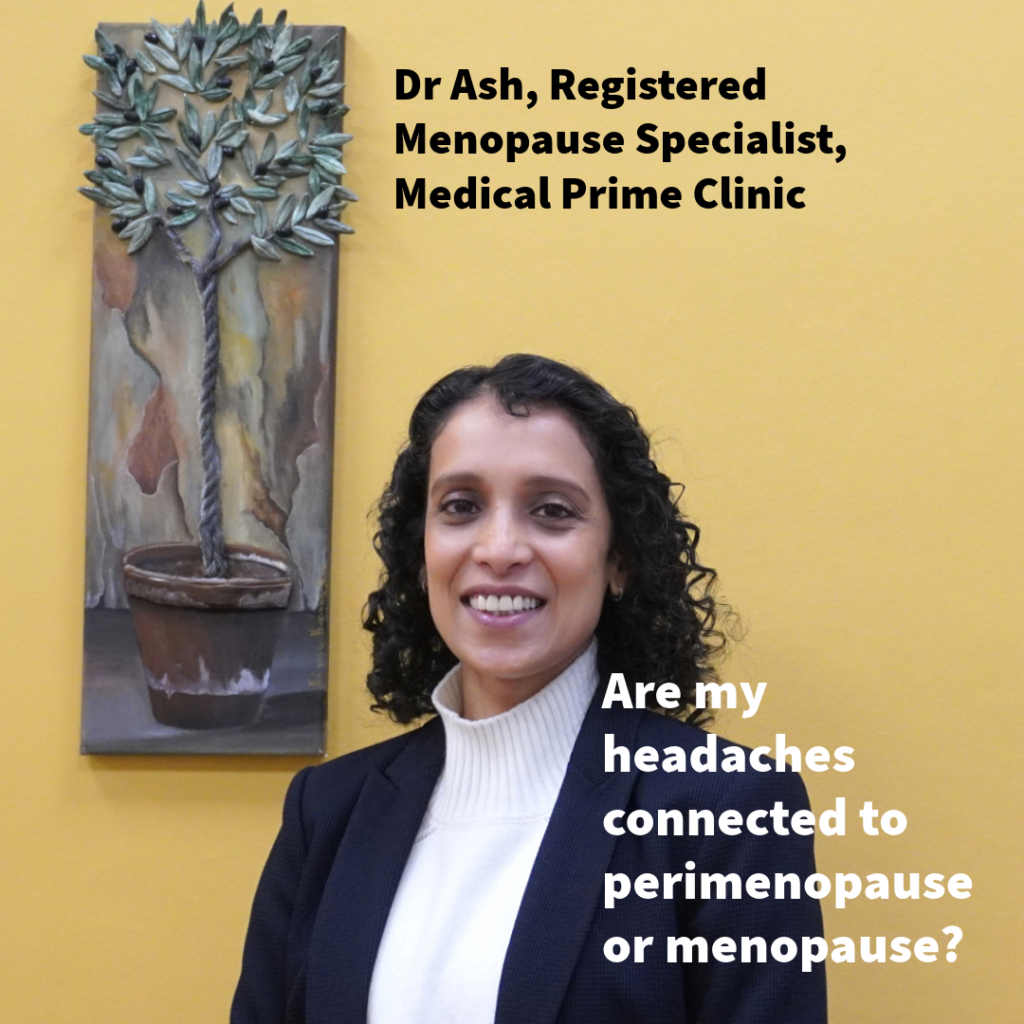
Are my headaches connected to perimenopause or menopause? Dr Ashlesha Dhairyawn, Registered British Menopause Society Menopause Specialist.
Headaches that once followed a fairly predictable pattern can become surprisingly erratic in the years around menopause. Migraines may arrive more often or feel harder to anticipate, while some women begin experiencing headaches they did not have before.
When changing periods, hot flushes or disrupted sleep appear around the same time, hormones are an obvious suspect. They can be part of the explanation. Fluctuating oestrogen during perimenopause can affect migraine patterns, particularly in women who have previously noticed a link between headaches and their menstrual cycle.
However, headaches have many possible causes. A new or changing pattern should not automatically be put down to menopause.
Why can headaches change during perimenopause?
Perimenopause is the transition leading up to your final menstrual period. During this time, hormone levels can fluctuate considerably rather than falling in a steady way.
For women who are sensitive to hormonal changes, these fluctuations can affect migraine patterns. Headaches may become more frequent, more intense or less predictable.
This can be particularly noticeable if migraines were already linked to the menstrual cycle. As periods become less regular, the hormonal changes that used to follow a more predictable monthly pattern can become harder to anticipate too.
Other symptoms of perimenopause can add to the problem. Poor sleep from night sweats, tiredness, stress, dehydration or missing meals may all make a headache or migraine more likely.
For some women, migraine improves after menopause once periods have stopped and hormone levels become more stable, although this does not happen for everyone.
Can headaches or migraines start for the first time?
They can.
Some women notice new headaches during perimenopause or menopause, even if headaches were not previously a significant problem.
A headache that appears around the same time as irregular periods, hot flushes, disturbed sleep or other menopause symptoms may have a hormonal contribution. That does not mean every new headache in midlife is caused by hormones.
Keeping track of when headaches occur can help reveal a pattern. It may be useful to note whether they seem to coincide with:
- Changes in your menstrual cycle
- Poor sleep or night sweats
- Hot flushes
- Alcohol
- Dehydration
- Missed meals
- Periods of increased stress
If the headache pattern is completely new, persists or changes quickly, speak to your GP rather than assuming menopause is responsible.
What do menopause related headaches and migraines feel like?
There is no specific type of headache that proves menopause is responsible.
Some women experience a dull or pressure like headache, sometimes with a tight sensation around the head. Migraine tends to be more disabling and may cause throbbing pain, often on one side, alongside nausea and sensitivity to light or sound.
Migraine can also occur with aura. Aura refers to temporary neurological symptoms that develop before or during some migraine attacks. These can include flashing lights, zigzag patterns or blind spots in your vision, tingling or difficulty finding words.
Not everyone with migraine experiences aura, and migraine does not always cause severe headache.
The change in pattern can be more informative than the exact sensation. Headaches that become more frequent or unpredictable around irregular periods and other perimenopause symptoms may suggest that hormonal changes are contributing.
What else can trigger headaches during menopause?
Hormonal fluctuations may lower the threshold for a headache, but they rarely act in isolation.
Common triggers include:
- Poor sleep
- Hot flushes and night sweats
- Dehydration
- Missing meals
- Stress
- Alcohol
- Too much caffeine or suddenly cutting down
- Tiredness
Sleep can be particularly important. Repeated waking because of night sweats may leave you more vulnerable to a headache the following morning.
Morning headaches can have other explanations too, including teeth grinding, sleep apnoea, dehydration and medication overuse. If headaches regularly appear on waking, it is worth looking at the wider pattern rather than assuming menopause is the only cause.
A headache diary can help. Record when the headache starts, how long it lasts, whether you are still having periods, any menopause symptoms around the same time and what you had eaten, drunk or taken for pain.
What can help when a menopause related headache starts?
For an occasional headache, simple pain relief such as paracetamol or an anti inflammatory medicine may help if these medicines are safe for you to take.
Migraine may need more specific treatment. Triptans are medicines used to treat migraine attacks and are available in different forms, including tablets and nasal sprays. Some are available from a pharmacy, while others require a prescription.
Anti sickness medication may also help if nausea or vomiting is part of the attack.
Practical measures can make a difference too. Resting somewhere quiet and dark, drinking enough water and avoiding missed meals may help when a headache begins.
If you are relying on painkillers or migraine medicines frequently, speak to your GP or pharmacist. Taking acute headache medicines too often can contribute to medication overuse headaches and make the overall pattern more difficult to manage.
Frequent or disabling migraines may also need preventive treatment rather than relying only on medication once an attack has started.
Can HRT make headaches or migraines better or worse?
Both are possible.
Some women find headaches improve with hormone replacement therapy (HRT), particularly when treatment also improves hot flushes, night sweats and disrupted sleep.
Others notice that headaches temporarily worsen after starting HRT or changing the dose. Headache is also a recognised side effect while the body adjusts to treatment.
For women with migraine who need HRT for menopause symptoms, transdermal oestrogen, such as a patch or gel, is generally preferred because it provides steadier hormone levels than oral oestrogen. Having migraine with aura does not automatically mean HRT cannot be used.
The aim is usually to use the lowest dose of oestrogen that controls menopause symptoms. Increasing the dose is not necessarily better for migraine and may make headaches worse for some women.
It can also take time to see how well a new HRT regimen suits you. If headaches begin or clearly worsen after starting HRT or changing the dose, speak to the clinician managing your treatment rather than adjusting it yourself.
When should a new or changing headache be checked?
Most headaches are not caused by anything serious, but a change from your usual pattern deserves attention.
Arrange a GP review if headaches are becoming more frequent or severe, regularly waking you, affecting everyday life or no longer responding to your usual treatment.
Seek urgent medical help for:
- A sudden, extremely severe headache
- New weakness or numbness
- Difficulty speaking
- New confusion or marked drowsiness
- Loss of vision or new persistent double vision
- A headache with fever and neck stiffness
- A seizure or loss of consciousness
- A severe headache after a head injury
A new persistent headache alongside unexplained weight loss, a history of cancer or other unusual symptoms should also be assessed.
If you are over 50 and develop a new headache with scalp tenderness, jaw pain when chewing or changes in vision, seek urgent medical advice.
Perimenopause can change headaches and migraines quite noticeably, but hormones should not become the automatic explanation for every new symptom in midlife. Tracking what has changed can help reveal whether there is a pattern, while medical review can clarify when something else needs to be considered.